Showing posts with label thinking. Show all posts

Wednesday, December 7, 2011

Magic Ink: Information Software and the Graphical Interface

Magic Ink: Information Software and the Graphical Interface: download the PDF

I came across this and I like the way he thinks of all interaction as basically information visualisation ( at least thats what I take away) . I love the change on Amazon he did get my gut reaction to it.


Example 
BEFORE ( AMAZON ) 


Worth a read ( is a bit long)

Friday, November 25, 2011

Strange grumpy observation of the day


There is a nice call up at the moment about Transforming Energy Demand in buildings through digital innovation. 

It sounds all very good and grand but for me it just shows how divorced research is from delivery. For example there is very little work on the design of domestic thermostats. Its just not that glamourous enough research to get funded ( even if someone was willing to do it - I mean you don't get in CHI for that kind of work).  Yet if you wanted to make a big impact quickly with out people campaigning against you then making sure the heating in the house was off when you were out ( i.e can you program your digital thermostat correctly ) would be the biggest use. 

Ruth and I were in conversation - we talked about tools for early stage impact on energy consumption for non domestic buildings. There is a system called BREEM which architects can use to guess the amount of energy there building will have. Did you know there are no BREEM or LEADS energy calculators on the iPhone or iPad. 

Strange omission.

Tuesday, May 17, 2011

CHI 3 Towards a theory of Interaction design a critique of the workshop at CHI2011

Towards a theory of Interaction design a critique of the workshop at CHI2011


I had the pleasure of attending the special interest group at CHI2011 entitled UX Research: What Theoretical Roots Do We Build On – If Any? The objective of the session was to attempt to investigate to see if there might be a common definition of and understanding of UX theory.


This is not the first time someone has attempted to do this. As just one example Paul Dourish in his book Where the Action is: The Foundations of Embodied Interaction suggested that to find an area of common ground it is necessary to abandon disembodied rationality and focus on skilled engaged practice using phenomenological practices.
The move to find some common theoretical ground is a positive one but during the workshop I witnessed a number of conflicts which I believe where unnecessary and counter productive.
Many of these conflicts arise from confusion over the meaning of theory from the differing component disciplines. By understanding these misinterpretations over the role of theory I believe it is possible to eliminate a lot of the problems and move more rapidly toward some kind of fundamental interaction theory.


What is theory ?
Theory is a term from ancient greek derived from theoria meaning a looking at view or beholding. It refers to contemplation as opposed to praxis (action or practice). This description still assumes that all academic disciplines use the notion of theory in the same way, which I contend is not true. Being on the boarder between the arts and the sciences HCI has come across a collision in paradigms between the two areas of practice. The domains of the arts and sciences have different notions over the role of theory and as such have different theories.


Science theory


Science theory is a well studied area but basically has a number of components. Firstly and to refute one misconception commonly used during the workshop there is no ONE theory or grand unified theory of science. Each domain has different theories depending upon context, so chemistry has the periodic table of elements while physics has theories such as electromagnetism, biology has evolution theory.
Confusingly physics has experienced intertheoretic reduction – were two theories such as the theory of electricity and the theory of magnetism have been combined to form one theory of eletro-magnetism. These intertheoretic identities are how ever rare and important steps in the progress of physics as an endevor. intertheoretic identities might give the impression to the outsider that there is one theory in physics but infact there are still a multiplicity of theories.
What makes science theory different is that if there are two theories which explain the same phenomena then it is generally possible to perform an experiment which appear to support one theory over another. This happened for example when the medical theory of the four humors (blood,yellow bile,phlegem and black bile) succumbed to more complex theories including bacterial infection theory. Scientific theories can be conceived of as compact descriptions of the phenomena they describe. As such well-collected empirical evidence is an important material along with experiments which appear to support or refute one theory over another. Finally generally scientific theories are also predictive. The limits are known to a strong extend and the significant parameters are known well enough that predictions can be made and ultimately tested. Scientific theories also tend to be reductive, they describe one phenomena really well but don’t seek to explain everything. Thus Galileo explained the presence of gravity but did so assuming the absence of air resistance. From an outsiders perspective he didn’t explain everything that falls ( the theory of gravity cannot explain the fall of a feather) but he did explain one aspect of movement which he considered widely important.


In terms of interaction and design scientific theories don’t tell you what to do just permit the inferring of consequences of doing so. An architectural analogy might help. Structural theories used by engineers permit them to predict if a design might stand up. Equally it is possible to say if you want a platform to stick out this far, from this material then it must be this thick. If you went to a structural engineer and said ‘I want a museum please calculate what should I build’ they wouldn’t have any idea. Scientific theories are descriptive but not generative. This can be quite liberating, for architects this means they are free to design anything they feel expresses the idea they want. With out this structural theory they would be forced to rely on precedence – previous successful buildings – something common in pre- structural theoretic cultures such as the medieval cathedrals of Europe. From this we can conclude that science theories are flexible and liberating for design.


Art theories


The second group of theories that are relevant are art theories. Art theories or design theories don’t have the property of being exclusive. Consider Cubism vs Dadaism it doesn’t make sense to consider one to be better than another,. they are not mutually exclusive and so intertheoretic reduction doesn’t apply. From this perspective art theories tend to be more prescriptive – they give a domain of consideration and a background of rhetoric to launch from. Thus when you begin a design there is already a condition to begin from, this is importantwhen a designer could be faced with creating something from nothing. Art theories gives them the property of being broad and cohesive, you can have a modernist painting, a modernist building, a modernist chair. Consider the process of creating a website and mobile version of a product ( not to mention physical documentation) scientific theories ( narrow and deep) will not help create a framework for action at this point but art theories do. Art theories often exist as a response to current conditions and can prefigure the works that compose them. As such art theories are very powerful generative tools in the hands of a skilled designer.


Summary
I have described two types of theory –art and science, but there are others, Mathematics, History, Politics and Philosophy all of whom use the notion of theory differently. It is important not to use scientific views of theory as bench marks for artistic theory, as it is not to use art theories to understand scientific ones. This said the diversity of theories creates for a rich structure and description of evaluation of user experience. If user experience is to thrive it needs to embrace the multicultural inheritance by admitting it’s presence and stop false comparison. This is not to suggest that there should and could not be a group of theories which lay purely in the domain of interaction design, just that they will have to be constructed between the two primary regions.

Monday, November 22, 2010

Ambiguity

William W. Gaver, Jacob Beaver, and Steve Benford. 2003. Ambiguity as a resource for design. InProceedings of the SIGCHI conference on Human factors in computing systems (CHI '03). ACM, New York, NY, USA, 233-240. DOI=10.1145/642611.642653 http://doi.acm.org/10.1145/642611.642653

Pondering over experiment

Pounding if I should make the experiment more complex. I spent a lot of time making it simpler. Now its too simple.

Also  found this link to time management for dyslexics.

Monday, May 24, 2010

HCI design technique or...


Sound like a familiar HCI methodology ? 
Quote{ 
Community-Based Planning refers to XXXX, Inc., research project aimed at developing ways for better understanding the needs of clients by using a variety of techniques. These include surveys, interviews, and questionnaires aimed at providing information about the organization; ethno- graphic observations and documentation aimed at understanding how the organization operates *********** and how it uses various relevant technologies; and, finally, codesign, involving users in the process of formulating design aims and design solutions. Community-Based Planning has led to the development of tools that are applied as part of XXXX's consulting services or made available to independent design firms. Both the principles and the tools associated with Community-Based Planning have been used in the case of ThoughtForm.
}

Actually it's also a design methodology for the design program for interior design for a new office 

The interior was designed by Michael Fazio, of Archideas, Chicago. The design program as well as the final solution were based on Community-Based Planning.

check out http://www.sss7.org/Proceedings/Seminars/Peponis%20et%20al%20-%20Designing%20Space%20to%20Support%20Knowledge%20Work.pdf for your selves. 

Monday, March 15, 2010

More thoughts on Narrative.

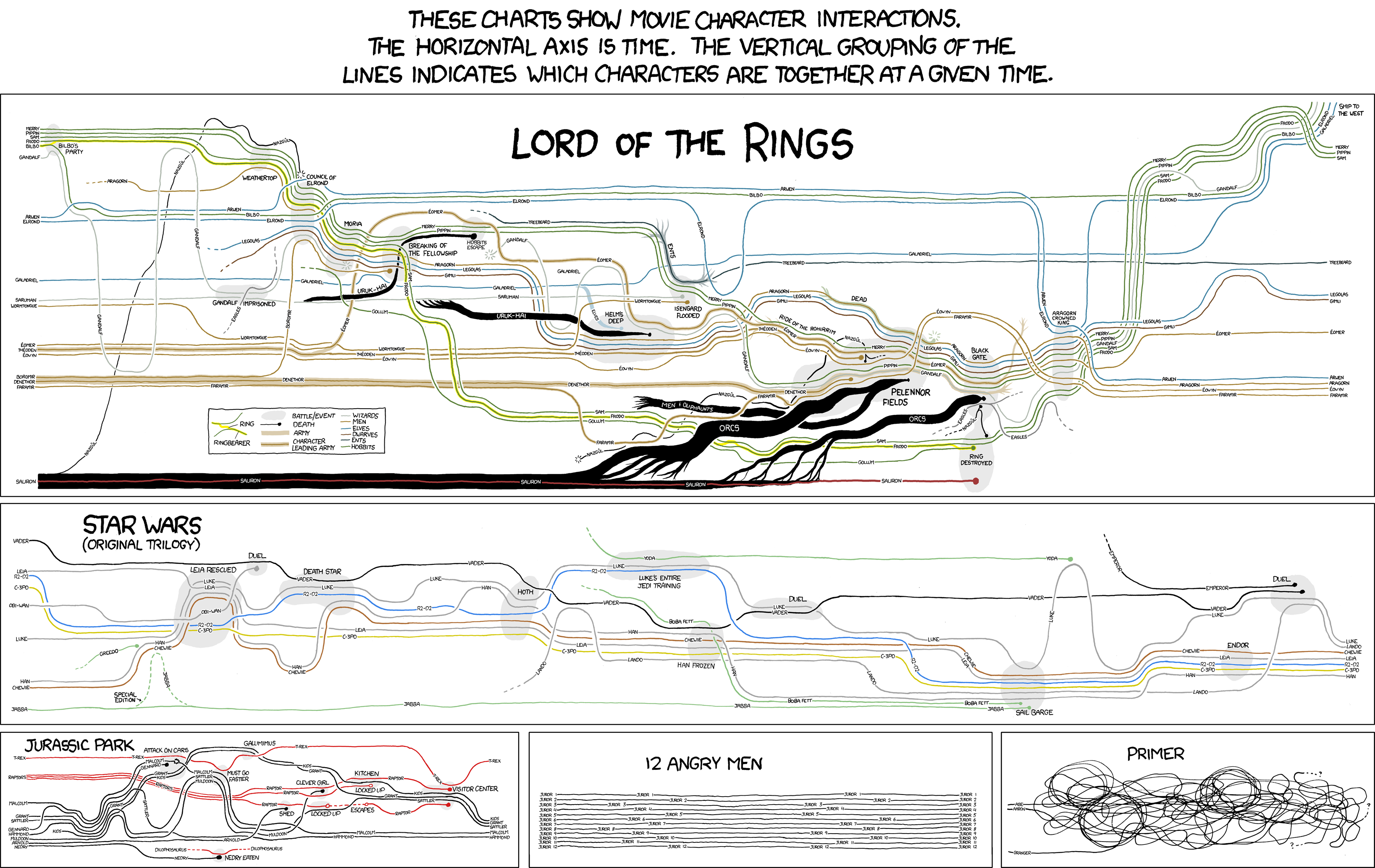
As you may know I've been thinking about narrative in the context of UI for a few weeks now. What drove me to this was the ex Head of Department's notion that what made the social work case go wrong was the absance of being able to track the narrative of the developments. I think there may also be a case in complex financial accounting forensics to track the actors in a case to help elucidate the over narrative of events. I wonder if the police use anything. It would have to be big to help. 

Something like this might make a good tabletop app. 

Narrative chart

Sunday, February 28, 2010

Norman Mailer and Marshall McLuhan on CBC in 1968

One of my interests is how/if we are made by technology how does it change our view of the world and our selves. I've been watching these and enjoying them immensly.
Interesting the notion of the pre/post TV generation which has resonances with the pre/post Internet generation ( I've heard them called digital natives).
Lovely to see prime time television from a point when people can say Faustian or Existential.


Violence is the search for identity.


McLuhan 'to select is to distort' so quote-alisious.
'All science and technologies are extensions of our own bodies' is another apt one.

Thursday, December 17, 2009

Digital ecology

I've spent most of today getting the cloud back into running order and showing some natural laguage people round. While doing that I've been thinking about some kind of future interface. I met up with T. and told him the interface is like a word on the tip of your tongue. Nearly there but you can't say it.

How did it start - talking about putting an interface on the Surface where if you put your IPhone on it the Iphone interface would 'spill its guts' on to the Surface letting you have more interface time and space. Like a full sized if virtual keyboard.
I wondered if you placed two Phones each running photos or calendars what would happen?
What would happen if you placed your phone next to your iMac the machines would notice each other and  communicate ( T mentioned the next generation iPhone would have an RFID tag) . How would your Laptop then expand the interface ?

So how would the interface work ? I like the idea of an intelligent layout manager and interface definition which would let you expand the iPhone/Android sized  app on to the bigger screens. It might be simpler to store multiple layouts too ( as Paul suggests). I like the idea of having resolution in the layout description allowing you  to specify what should go when the interface is reduced.

I'm thinking we need a  whole new GUI/OS something that would support the notion of 'user',  mutli-treading in the rendering layer,  a cloud based model, seeing things like the Microsoft 2020 vision I'm thinking it would be good to have animation based at the lowest level.

Sunday, May 17, 2009

Thoughts on technology

1. Science and technology are different things. People even particanters frequently merge to the two together but they are not the same thing. One does not lead to the latter. When an atomic physicist builds an atomic bomb they actually become atomic engineers. They are engaging in a separate process, with separate rules and separate processes and outcomes. Science has higher credence with the wider population so sometimes subjects are miss represented to maintain cultural funding.

1.1 Scientists and Technologists think differently about things. For a scientists the ultimate outcome is promotion of self and their perticualr beliefs. For engineer the ultimate outcome is the promotion of the changes made by the technologist them selves the self is unimportant. This is ego centric and world centric production.

2. I might contend that science is an extension a practice based upon technology. A microscope ( technology ) is invented and this leads to a number of scientific discoveries. Many scientists engage in technological development in the name of science and it is these developments which frequently 'spin off' into technology rather then the scientific results. Scientific knowledge is largely ignored (or not researched )when developing new products. I would contend the creation of new medical drugs is largely an technological process rather than a scientific one.

3. A technology is defined by the experience of it - what it affords. A table or chair is hard to define until you define what it lets you do with it you couldn't do with out it rather than what it is. For many engineers this is what might be termed 'utility'. But utility has a number of preconceptions about what is good and what is 'bad'. For example making a game or something fun is an affordance but does not sit well with most engineers vision of 'utility'.

4. The affordance drives the adoption mediated by the process of capitalism.
Today I felt very sorry for the people marching for jobs outside parliament. If they want to have some kind of influence they should have really marched outside some venture capital buildings.

Venture capital is driven by risk rather than understanding the technology and its outcomes so you get some strange results. Venture Capital has its own logics which limits what it can and cannot do. For example VC cannot stray to far outside the current technological domain.

5. All new products are the process of either technology push ( technology affordance) and market pull. I would content a successful project is actually a combination between the both. Pull is the potential market and push is why your potential competitors havn't met that need yet.

6. Market need is a myth. Who sat round in the 1820's saying if only we could get from London to Manchester in 3 hours life would be so much better? Needs are only discovered/perceived by creating methods to meet those needs. This what we think of as market need is simply known technological affordance (If I can get from London to Manchester in 3 hour how could I use that). When it looks like you are assessing market 'needs' then you are only applying knowledge of current known solutions rather than being open ended about speculating entirely new ones. It is very difficult to frame a question where a true need is identified, and if it was done generally then its moderatly unlikely that the technologist in question will be able to innovate sufficiently to meet that need.

7. All technology is in fact driven by appropriation. Appropriation is process of users seeing affordances which have not been perceived of by the original creators. Phoning your self up to leave a message as a reminder is example of appropriation. In fact appropriation drives all new technologies. Only does meeting a need ( for filling a new affordance) leading to substantive innovation but this assumes the technology creator knows both the aforndance and the likely appropriation - which can happen but is rare.

8. Appropriation also cultural -in modern society we use thing to meet social needs most of our vital needs are already catered for. So for example people might consider solar panels on their roofs but not insulation in their buildings. The movie and digital media are pushing them selves towards extinction due to digital copyright problems. The obvious solution would be to demand analogue storage devices (DVDs) which would inheriantly introduce noise into the picture and so make copying difficult. But they cannot due to the view of digital media being 'the future'.

9. Appropriation can occur for non discursive reasons. SUV/4x4 met a non discursive need.

10. The experience of technology is fundamental to our relationship to it and the every day.

11. Some technologies are about what to think with and some are about what to think of.

Tuesday, May 12, 2009

Thinking.

I was reading this

1. B. Hillier, “Between Social Physics and Phenomenology: explorations towards an urban synthesis?,” in Proceedings of the 5th International Space Syntax Symposium, vol. 1, 2.

And started to make lots of links between Phenomenology/Ethnography and HCI. In essence David Seamon has made a lot of interesting noises about how the architectural theory space syntax links in with phenomenology mostly the phenomenology of space. Due to the focus on building from experience to create life in the streets. I see phenomenology/syntax as a very complementary views of the world. Hillier sees it as a bridge between phenomenology and social physics (his term).

I was talking about this with Paul and Riche saying how what I would like to do for HCI what syntax did for urban design. Effectively create a theory of object (software) which could be used analytically for design. Currently we operate from theories/practices of human (psychology) and society ( Ethnography ) which gives the computing people/designers little to contribute but interventions. Is this getting to the essence of HCI ( to use the phenomenology).

I guess what I'm looking for what is called space in architecture but for HCI. Space in architecture is a very abstract concept but is very familair (you by the building by the price per sqr foot), is not that which we build it is defined by what we build, it is what we build for and what architects think we respond to.

Richie said something interesting, when you are looking for a new house you look at the empty rooms and think what you can do with them. In HCI terms your looking for the affordances of the builds volume/void/space. But we don't talk about specific affordances the way space syntax can be specific and objective about space.

Going back to the rooms , when I look at Excel, or word don't think about what it is I think about what I can do with it. So Excel has a large 'interaction-space' for want of a better word. Clearly both Excel and Word set an agenda but are very flexible within in that realm. I'm still not sure what I mean.

Richie also had that zen moment about space defining the bowl. When you buy a bowl all it does is to define that space, with out that space it is not a bowl. Bill also talks about things forming from relationships of object, a table is just a number of chunks of wood until they form in a specific set of relationships. Perhaps the table is also the space it defines underneath it and above it.

I'm speculating but perhaps the space in things is the paths through the things we flow through when we use them. The orders of clicks and pages on a web site the sequences of clicks on a mobile phone. Are these paths essential uses of things are they part of our use of things?

M. recommended S. Todes, Body and world (MIT Press, 2001). to check out. Looks embodied.



Tuesday, March 17, 2009

Yvonne Chat

With Paul and Jeff away I was treated to a some uninterrupted time with Y. Its always good to talk to her it lends me more clarity. 

Things I've go to remember. 
  • Start writing up the atrium stuff now don't wait for stats. This gives time to get some review. This is much larger pond I'm in and the bar is that much higher. 
  • Need to get some lite demos working for the table for DANA
  • Need to think carefully about the work for the touch table. 
  • Looks like the big atrium test will be interesting. 
  • Have to time manage the library tests too. ( Chi is coming soon). 
Chatted about i-steam. We both like the way that at the moment you can develop a small interesting app and make a money from it with out the huge team of people working on it. I found it interesting the way that people have found interesting uses for the phone sensors ( shaking, touch, orientation, blowing on the microphone). Less complete than the early Xerox inspired mouse/keyboard/Graphic UI more open to appropriation some how. 


OK back to 801 Marking. 

Friday, February 27, 2009

Experiment from hell well..

This morning the expierment ended and I sent out the questionnaire. Paul made some last minuet adjustments which took me an hour to produce. Sent out the invite email and then got on the train to have a meeting at the DANA centre.

Talking with Y said I would be OK with min 15 responses and could write a paper with 20. In fact I had 15 partial with 19 full responses. I'm quite impressed people remembered words from a month ago to! Inital reponses look to be the reverse of what I was expecting but I have to chase up people in computer science to take part.

Monday, January 26, 2009

More evil ideas

Puma

Origin: COCONUT 
Physical meaning: inverse kinematics of a 3R robot 
8 equations with 8 unknowns

  x1^2 + x2^2 - 1 =0 x3^2 + x4^2 - 1 =0 x5^2 + x6^2 - 1 =0 x7^2 + x8^2 - 1 =0 0.004731*x1*x3 - 0.3578*x2*x3 - 0.1238*x1 - 0.001637*x2 - 0.9338*x4 + x7=0 1 =0 0.2238*x1*x3 + 0.7623*x2*x3 + 0.2638*x1 - 0.07745*x2 -0.6734*x4 -0.6022 =0 x6*x8 + 0.3578*x1 + 0.004731*x2 =0 -0.7623*x1 + 0.2238*x2 + 0.3461 =0 
Ranges: [-1,1] for all unknowns 

Solving method: GradientSolve+HullConsistencyStrong+ +3B 
Solutions:: 16 (exact) 
Computation time (May 2004):

So output the sum of all the outputs ( how far from zero they are). 

Tuesday, November 18, 2008

More glassy idears

We had a meeting today about getting another study underway.  This time thinking about horizontal vs vertical spaces.

Afterwards I passed through the old department and saw a couple of foldable tables which might be nice to make a semi-portable reatavision table. 

Got to thinking about making a multi-touch surface using a projector against a large sheet of glass with tracing paper as the projection surface. Could we track fiducials in the IR from behind the glass. The problem is that the markers would not 'sick' to the vertical surface. Useful for manipulation but not objects. 

I'm wondering what kind of interface I could build with that - perhaps something for NATS. 

Jeff said something quite profound - we should stop thinking about technologies and think about user studies. 

I also worked on the audio interface as a relax/quickie paper. I think I have enough voices for a run through. 

Tuesday, November 11, 2008

Ambient displays


This artwork by Susanna Hertrich works well on two levels.

Firstly I like the idea of something embedded into a mirror,  especially in a domestic situation.  A mirror is definitely something you look at or rather glance at something you  might want to consider as you move in and out of the building - this is something the art work side aludes to.

As I think Kay said I think that you need something you don't touch directly. So I like the interface at the bottom of the screen and clearly making a one action interface makes it very approachable.

Secondly as  a very personal interface - you see things about you ( again the art work does well on this). Quite easy to think of a number of less exciting interfaces here - (calendar, appointments). it might be a good time to remind you about you permit the user to do things in a persuasive computing sense. It would also work well as a dwelling interface - you could see a graph of energy use but have that compared to other people you know or are families like yours.

I also liked the animated interface - reminds you how poorly structured most user interfaces are for animation/movement.

Both we and IET have a number of half silvered mirrors - so one could prototype some kind of interface quite simply. As for a shareable I like the notion of a mirror that 'captures' previous glances. You might see pictures of people entering and leaving recently or pictures of your self a year ago.I guess its obvious and it must have been done. Perhaps some combination with that skin colour tracking you could make an nice interface. I have some good face tracking code that might work well for something.

I think i like the more physical waste of time interface.

http://www.susannahertrich.com


Conversation with jeff - use pinch as a 'selection' mechanism. 
Conversation with Kay  - she tried arm waving (not working) but holding hand near and still until it 'warms' up (visual indicator changed) did work.

Sunday, June 29, 2008

Arduino Diecimila one for the shopping list.


Ok so I have done the workshop and very fun it was to.


OK so the  Arduino Diecimila is small computer with sensing inptus/outputs and you can stick the  ArduinoXbee Series2 on. The  ArduinoXbee is a wireless networking forming a mesh - true hard core ubicomp territory. All for 57-61 Euros but you need at least 2 to begin with ( the more the better ).


They also do a bluetooth one.


Very simple to do the observing the building 'buzz' project.


I'm going to keep thinking about these - If i could think of something shareable I'lll talk about it.


Wednesday, March 19, 2008

iphone sdk available

I've been working on the UIST paper and getting side tracked looking at new iPhone developer stuff. All objective C and very swish too, I could get something working quick but I think lots of other developers would have a steeper learning curve. 

Makes me wonder what I might write if I had the inclination to make an application for cash. Something weby mashupy comes to mind but does this use the multi touchness? Some ideas are leaking into my mind but nothing definite. 

Sunday, February 24, 2008

hobby research page ranking == degree


Hi - Here is one I came up with to night. I know I've always been quite dismissive of that paper on page ranking ( the kind google does to figure out how to rate things) in the GIS journal as a cheap way to do a naff syntax rip-off with out referencing the social logic of space. I basically assumed that the page ranking algorithm would produce the same kinds of output as integration or at possibly choice (sounds choicy when you here the algorithm). 
I was reading a new book on collective intelligence which explained the google page ranking algorithm and was curious enough to put it into webmap at home.  Doing this I was disappointed to find that page rank correlates well with (0.95) with connectivity / control and very badly integration(0.35)choice(0.77)/movement. 

This might not be true for small world graphs ( which axial maps are not). 

Thought I would include map of Barnsbury for your amusement. 

Friday, January 18, 2008

post demo conversation

The day after the demo day before. 

Had a conversation with Jeff, ended up with the question given we are at such a delicate  time in the evolution of table top technology we must as our selves - what might the killer app for table tops be?